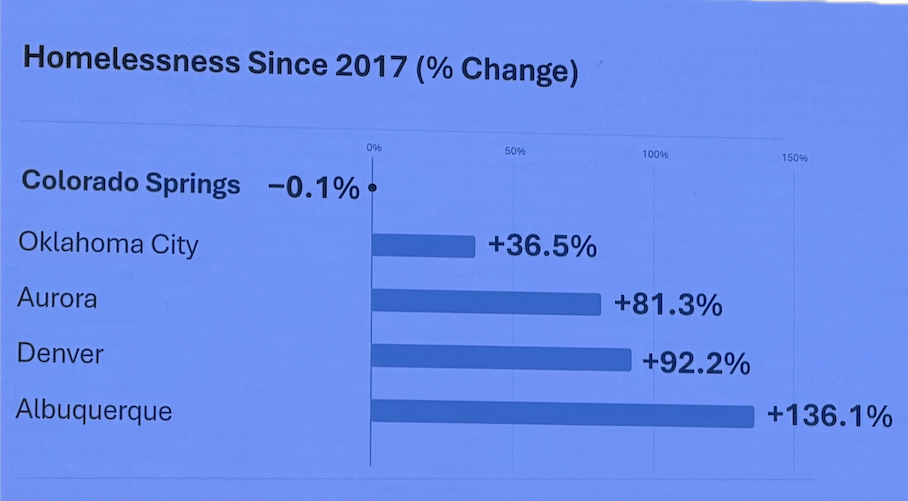
On Friday, I attended the State of the City address, where Mayor Yemi Mobolade shared the progress Colorado Springs has made in his three years in office. One slide stood out to me, and I want to walk through what it means, especially for the veterans and military families who make this city what it is.
How has homelessness in Colorado Springs changed since 2017?
The mayor compared Colorado Springs with four nearby and peer cities. Here is how homelessness has changed in each since 2017:
- Colorado Springs: -0.1%
- Oklahoma City: +36.5%
- Aurora: +81.3%
- Denver: +92.2%
- Albuquerque: +136.1%
Other cities in our region have seen homelessness nearly double or more. Colorado Springs has held essentially flat.
What did the 2026 Point-in-Time count find?
The Point-in-Time (PIT) count is a one-night tally done each January in communities that receive federal homelessness funding. The 2026 count for El Paso County found:
- 1,413 people experiencing homelessness, 19% fewer than in 2025
- 1,105 people in shelters or transitional housing
- 308 people unsheltered, and the mayor reported a 41% drop in unsheltered homelessness
The numbers are encouraging, but they are not the whole story. A PIT count is a snapshot of a single night, and local providers are quick to say it does not capture everyone. Earlier this year, a state report ranked El Paso County’s homelessness rate as the highest in Colorado. Both things can be true: real progress, and real work still to do.
How many veterans are experiencing homelessness in Colorado Springs?
The January 2026 count found 131 veterans experiencing homelessness in El Paso County, about 9% of everyone counted. The year before, the count was about 195, or 11%. That is roughly one-third fewer veterans without a home in one year.
The national trend points the same way. A new analysis from the nonprofit Community Solutions, reported by Military.com, projects:
- Veteran homelessness will fall 8.2% nationally in 2026, the largest drop in more than 10 years.
- The national count is expected to fall below 30,000 for the first time since veterans were added to the PIT count in 2009. In 2011, it was about 75,000.
- Since 2022, veterans have been less likely to experience homelessness than non-veterans. Veteran status used to be a risk factor and is now considered a protective factor.
Researchers credit sustained investment in programs like HUD-VASH, which pairs housing vouchers with VA support services, along with work at the state and local levels.
Why does veteran homelessness matter so much here?
Few cities have a military footprint like ours. Colorado Springs is home to five military installations:
- Fort Carson
- Peterson Space Force Base
- Schriever Space Force Base
- The U.S. Air Force Academy
- Cheyenne Mountain Space Force Station
The numbers show the scale:
- Active duty: Fort Carson reports 23,716 active-duty soldiers and 57,220 family members. Peterson and Schriever add another 6,373 active-duty members. That is more than 30,000 active-duty service members at those three installations alone, before counting the Academy and Cheyenne Mountain.
- Veterans: About 54,500 veterans live in Colorado Springs, roughly 14.6% of residents, or about 1 in 7. The broader region is home to more than 80,000 veterans.
- Transitions: More than 350 service members separate from Fort Carson, Peterson and Schriever every month. Many of them decide whether to stay in Colorado Springs as civilians.
A transition out of uniform is one of the biggest life changes a family can make, and housing is a big part of it. When the community has strong support in place, more veterans land on their feet here.
What support is available for veterans in Colorado Springs?
This week, Mt. Carmel Veterans Service Center is hosting the 28th annual El Paso County Homeless Veterans Stand Down at Weidner Field. Veterans can get help with housing, VA benefits, healthcare, job searches, warm winter gear, and new this year, free legal help from Colorado Legal Services.
What does this mean for our community?
As a retired Army spouse, I know how much this city gives to military families, and how much they give back. Seeing fewer veterans without a home is progress worth celebrating, along with the organizations, volunteers and service providers who made it happen. It is also a reminder to keep going.
Frequently Asked Questions
Did homelessness go down in Colorado Springs in 2026?
Yes. The 2026 Point-in-Time count found 1,413 people experiencing homelessness in El Paso County, a 19% decrease from 2025. Unsheltered homelessness fell 41%.
How many homeless veterans are in Colorado Springs?
The January 2026 count found 131 veterans experiencing homelessness in El Paso County, down from about 195 the year before.
How many veterans live in Colorado Springs?
About 54,500 veterans live in the city, roughly 14.6% of residents. More than 80,000 veterans live in the greater Pikes Peak region.
What military bases are in Colorado Springs?
There are five: Fort Carson, Peterson Space Force Base, Schriever Space Force Base, the U.S. Air Force Academy, and Cheyenne Mountain Space Force Station.
Is veteran homelessness going down nationally?
Yes. Community Solutions projects an 8.2% national decline in 2026, the largest in more than a decade, with the total expected to fall below 30,000 for the first time.