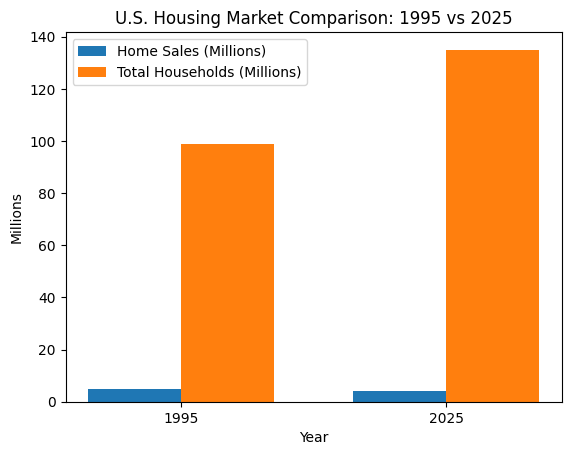
The U.S. housing market closed 2025 with approximately 4.061 million home sales, the lowest annual total in roughly 30 years, a level last seen in 1995. At face value, that comparison suggests a weak housing market. However, when household formation data is layered in, a very different story emerges.
This is not a collapse in housing demand. It is a structural supply and mobility issue.
In 1995, the United States had just under 99 million households, and annual household formation averaged about 1.1 million new households per year. Home sales at that time hovered just above 5 million units, aligning relatively closely with household growth.
Fast forward to 2025. The U.S. now has approximately 135 million households, an increase of more than 36 million households since the mid-1990s. Despite that dramatic growth, home sales have fallen below mid-1990s levels.
Household formation has not stopped. Even with slower growth than prior decades, the U.S. is still adding roughly 800,000 to 900,000 new households each year. These households still require housing. What has changed is the ability and willingness of existing homeowners to move.
Several factors are suppressing transaction volume:
-
Mortgage rate lock-in for homeowners with sub-4 percent loans
-
A long-term shortage of new construction
-
Affordability pressures from higher prices and rates
-
An aging population choosing to remain in place longer
Together, these forces restrict inventory and limit movement, even as demand continues to exist beneath the surface.
Low transaction volume does not mean low opportunity. Buyers face less competition in certain segments, while sellers benefit from limited inventory and serious, qualified buyers. Understanding the difference between low activity and low demand is critical when making housing decisions.
When placed in proper context, 2025’s housing data does not signal a shrinking market. It reflects a market constrained by supply, affordability, and mobility, not a lack of households needing homes.
For those evaluating timing, pricing, or relocation decisions, including those moving to Colorado Springs, local market analysis and strategy matter more than national headlines.
Tags
#HousingMarket2025 #HomeSalesTrends #HouseholdFormation #RealEstateData #HousingSupply #Affordability #ColoradoRealEstate #ColoradoSpringsHousing #RealEstateEducation
Connect and Follow
LinkedIn: https://www.linkedin.com/in/nicolestromrealtor/
Instagram: https://www.instagram.com/nicole_strom_realtor/
Facebook: https://www.facebook.com/Colorado.Springs.REALTOR.Military
YouTube: https://www.youtube.com/channel/UCohPtBrINuizMZT_mTPx9rg
Website: www.NicoleStromRealtor.com
Phone: 719-922-0102